
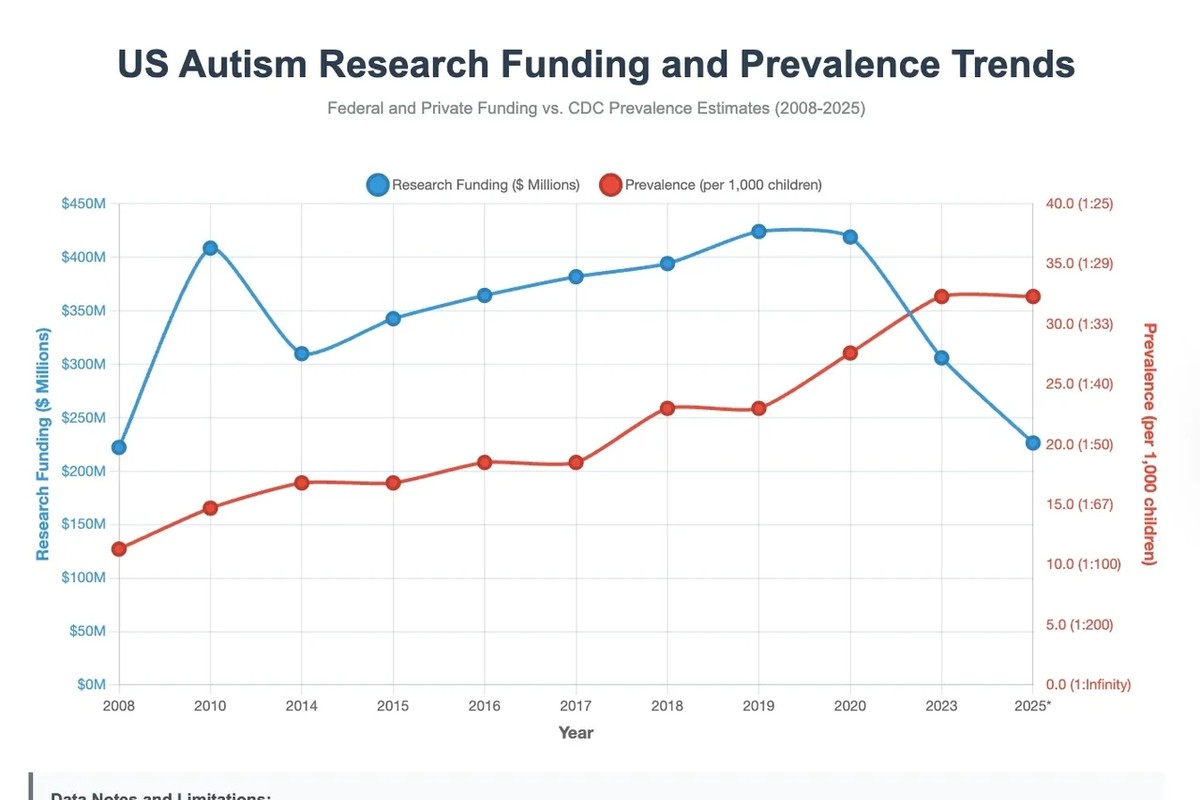
The 2025 CDC report indicates autism prevalence at 1 in 31 children in the United States. The trend from the 1 in 88 data in 2008 shows an alarming increase. Evaluating how research funding was allocated to this growing prevalence gives information to students and healthcare professionals about research priorities and resource availability. The funding patterns in the US also have global implications, particularly for countries in Africa where autism research infrastructure is still developing.
Autism research funding in the United States began at $222.2 million in 2008 and experienced dramatic growth to a peak of $408.6 million in 2010, largely due to stimulus funding from the American Recovery and Reinvestment Act (Interagency Autism Coordinating Committee, 2010). After this peak, funding stabilized and grew more gradually, reaching $424.2 million in 2019 before declining to $306 million in 2023 (National Institutes of Health, 2023). The most concerning recent development occurred in early 2025, when reports indicated a 26% reduction in autism research funding, representing approximately $31 million less than the previous year (Wadman, 2025). This decline coincided with a shift in research priorities toward environmental and vaccine-related studies, potentially reducing support for other critical areas like services research and intervention development.
Federal agencies provide approximately 81-82% of autism research funding, with the National Institutes of Health serving as the primary funder (Interagency Autism Coordinating Committee, 2017). Private organizations contribute the remaining portion, including foundations like the Simons Foundation, which contributed $55.3 million in 2017, and Autism Speaks, which provided $9 million that same year. The Department of Defense also supports autism research through its Autism Research Program, focusing on innovative approaches that complement NIH efforts.
Historically, autism research has emphasized basic science and biological studies. Risk-factor research received 37% of funding in the early 2010s, while treatment-related studies accounted for 24% (Interagency Autism Coordinating Committee, 2010). However, significant gaps persist in services research, which received only 9% of total funding from 2008-2018 despite the growing population needing practical interventions (Cervantes et al., 2021). This represents a concerning mismatch between research investment and practical needs.
Other underfunded areas include research on disparities, which received 6% of funding, and studies focusing on women and girls, which received only 1.9% of funding. These gaps suggest limitations in understanding autism across diverse populations (Interagency Autism Coordinating Committee, 2022).
When examining autism research funding in context, the $306 million allocated in 2023 represents a fraction of funding for other conditions. Cancer research received $7.6 billion, and Alzheimer's disease research received $3.7 billion in the same year (National Institutes of Health, 2023). While these differences reflect varying factors including prevalence, mortality rates, and advocacy efforts, they show the relative investment in autism research compared to other health conditions.
Research on autism in Africa looks very different relative to the US funding landscape. Autism spectrum disorder prevalence is estimated to be approximately 1 in 100 children worldwide, but data from Africa remains limited and inconsistent, with varying estimates reported across different African countries. Studies from Nigeria report prevalence rates of 2.3% to 2.9%, while Uganda reports 0.68% (Lagunju et al., as cited in research by Abubakar et al.).
Nigeria has contributed the most autism research in sub-Saharan Africa, with 27 out of 41 studies identified in West Africa originating from Nigeria (Adams, 2024). A school-based study in Southeastern Nigeria documented autism prevalence of 2.9% among children aged 3-18 years (Bakare et al., 2018). However, significant challenges remain in diagnosis and treatment access. Lack of funding creates a lack of awareness, limited access to professional support, and diagnostic tools. Healthcare professionals have limited access to training in autism, and often can’t support the needs of the families who sometimes may attribute autistic behaviors to supernatural causes (Adams, 2024). The limited data on autism across the continent results from various factors, including low awareness of the condition, inadequate diagnostic and assessment tools, and stigma associated with mental health disorders. Only 6 out of 16 West African countries have published autism research, creating substantial gaps in epidemiology, etiology, diagnosis, and treatment research (Akins et al., 2021). This research scarcity occurs even though approximately 95% of autistic individuals live in low-to-middle-income countries, while most autism knowledge originates from high-income countries (Adams, 2024). The lack of standardized diagnostic criteria and assessment tools makes comparing findings across different African populations particularly challenging. Often combined with stigma surrounding mental health disorders and limited awareness of autism as a condition, these factors create significant barriers to research progress (Abubakar et al., 2023).
The reduction in US autism research funding could significantly affect African autism research development. Many African researchers depend on international collaborations and training opportunities funded through American institutions. Reduced funding may limit these partnerships, affecting capacity building in countries like Nigeria, where autism research is emerging. Training programs that facilitate African researchers' visits to US institutions may face budget constraints, reducing knowledge transfer opportunities. Collaborative research projects examining autism across diverse populations may receive less support, limiting understanding of how autism presents in different cultural contexts. Technology transfer initiatives for diagnostic tools and intervention strategies may also experience delays.
The timing of these funding reductions is concerning. As African countries begin developing their research capacity, the primary source of international collaboration faces budget constraints. This creates a challenging situation where regions with the greatest need for autism research development have reduced access to resources. Given that funding for autism should be prioritized to improve access to care, including trained healthcare professionals, specialized centers and schools, and appropriate tools and resources, reduced US funding makes it difficult.
Several important limitations affect the interpretation of these funding and prevalence trends. The 2025 US funding data represents only partial-year reporting from January through April, which may not reflect full-year patterns (Wadman, 2025). Historical funding figures have not been adjusted for inflation, potentially overstating real growth rates over time. For African data, the absence of standardized diagnostic criteria and assessment tools for autism makes comparing results across different populations difficult. Prevalence estimates may not represent entire countries accurately, as studies often focus on specific regions or populations rather than providing nationally representative data.
The divergence between rising autism prevalence in the US (from 1 in 88 to 1 in 31 children) and recent funding reductions highlights concerning trends in research resource allocation. Priority areas like intervention research remain underfunded, especially when growing populations require more support. In Africa, future research development could benefit from community-based epidemiological studies to establish accurate prevalence estimates.
While autism research funding in the US has grown substantially since 2008, recent reductions raise concerns about maintaining research momentum as prevalence continues to increase. The implications extend globally, particularly affecting regions like Africa, where research infrastructure depends heavily on international partnerships and collaboration. For students and healthcare professionals, understanding these funding patterns is important. It can inform decisions when identifying current research priorities, the need for advocacy, and resource allocation.
The figure presents a dual-axis line graph from years 2008 to 2025, illustrating the relationship between US autism research funding (left y-axis, measured in millions of dollars) and autism prevalence (right y-axis, measured per 1,000 children aged 8 years). The graph has two colored line paths to represent two trends. The left y-axis displays funding levels from $0 to $450 million, represented by a blue line with circular data points. The right y-axis shows prevalence rates from 0 to 40 per 1,000 children, depicted as a red line with similar data points. The dual-axis design helps to direct visual comparison of these trends despite their different units of measurement.
The most prominent feature is the sharp peak in 2010 ($408.6 million), clearly visible as the highest point on the blue funding line. This peak represents stimulus funding from the American Recovery and Reinvestment Act. The red prevalence line shows a consistent upward trend from 11.3 per 1,000 in 2008 to 32.3 per 1,000 in 2022, with the slope becoming steeper in recent years. The most concerning pattern is in 2025, where the blue funding line drops sharply to its lowest point ($226.4 million) while the red prevalence line remains at its highest level (32.3 per 1,000).
Interactive hover functionality reveals specific values and displays prevalence both as rates per 1,000 and in the more familiar "1 in X" format (for example, 32.3 per 1,000 equals 1 in 31 children). The 2025 data point includes an asterisk to indicate its estimated nature. Important limitations include that prevalence data from 2022 is extended through 2025 due to a lack of newer CDC data, the 2025 funding estimate is based on partial-year reporting, different methodologies for data collection across years may affect comparability, and last, the graph shows correlation rather than causation between funding levels and prevalence rates.
The gap between the two lines in recent years, particularly the sharp separation in 2025, visually represents a mismatch between growing identification of autism and declining research resources. This pattern raises important questions about research priorities and resource allocation as needs continue to increase.
This analysis is based on data through 2025 but has not undergone peer review and would benefit from more comprehensive investigation, including inflation-adjusted funding figures, detailed analysis of international collaboration impacts, and longitudinal assessment of research relative to funding levels.
References
Abubakar, A., Ssewanyana, D., & Newton, C. R. (2023). Autism in Africa: prevalence, diagnosis, treatment and the impact of social and cultural factors on families and caregivers: a review. Annals of Medicine and Surgery, 81, 103386.[ https://doi.org/10.1016/j.amsu.2022.103386](https://doi.org/10.1016/j.amsu.2022.103386)
Adams, S. N. (2024). The unmasking of autism in South Africa and Nigeria. Neuropsychiatric Disease and Treatment, 20, 461650.[ https://doi.org/10.2147/NDT.S461650](https://doi.org/10.2147/NDT.S461650)
Akins, R. S., Angkustsiri, K., & Hansen, R. L. (2021). Picture of autism spectrum disorder (ASD) research in West Africa—A scoping review. Research in Autism Spectrum Disorders, 89, 101663.[ https://doi.org/10.1016/j.rasd.2021.101663](https://doi.org/10.1016/j.rasd.2021.101663)
Bakare, M. O., Ebigbo, P. O., Agomoh, A. O., & Menkiti, N. C. (2018). Autism spectrum disorders in Nigeria: A scoping review of literature and opinion on future research and social policy directions. Global Health Research and Policy, 3, 17.[ https://doi.org/10.1186/s41256-018-0074-6](https://doi.org/10.1186/s41256-018-0074-6)
Cervantes, P. E., Seag, D. E. M., Nelson, K. L., & Shea, L. (2021). Trends over a decade in NIH funding for autism spectrum disorder services research. Journal of Autism and Developmental Disorders, 51(8), 2751–2763.[ https://doi.org/10.1007/s10803-020-04746-3](https://doi.org/10.1007/s10803-020-04746-3)
Interagency Autism Coordinating Committee. (2010). 2010 IACC autism spectrum disorder research portfolio analysis report. U.S. Department of Health and Human Services.[ https://iacc.hhs.gov/publications/portfolio-analysis/2010/](https://iacc.hhs.gov/publications/portfolio-analysis/2010/)
Interagency Autism Coordinating Committee. (2016). 2016 IACC autism spectrum disorder research portfolio analysis report. U.S. Department of Health and Human Services.[ https://iacc.hhs.gov/publications/portfolio-analysis/2016/](https://iacc.hhs.gov/publications/portfolio-analysis/2016/)
Interagency Autism Coordinating Committee. (2017). 2014–2015 IACC autism spectrum disorder research portfolio analysis report. U.S. Department of Health and Human Services.[ https://iacc.hhs.gov/publications/portfolio-analysis/2015/](https://iacc.hhs.gov/publications/portfolio-analysis/2015/)
Interagency Autism Coordinating Committee. (2021). 2017–2018 IACC autism spectrum disorder research portfolio analysis report. U.S. Department of Health and Human Services.[ https://iacc.hhs.gov/publications/portfolio-analysis/2018/](https://iacc.hhs.gov/publications/portfolio-analysis/2018/)
Interagency Autism Coordinating Committee. (2022). 2019–2020 IACC autism spectrum disorder research portfolio analysis report. U.S. Department of Health and Human Services.[ https://iacc.hhs.gov/publications/portfolio-analysis/2020/](https://iacc.hhs.gov/publications/portfolio-analysis/2020/)
National Institutes of Health. (2023). Estimates of funding for various research, condition, and disease categories (RCDC).[ https://report.nih.gov/funding/categorical-spending#/](https://report.nih.gov/funding/categorical-spending#/)
U.S. Congress. (2019). Autism Collaboration, Accountability, Research, Education, and Support (CARES) Act of 2019, Pub. L. No. 116–60.[ https://www.congress.gov/bill/116th-congress/house-bill/1058](https://www.congress.gov/bill/116th-congress/house-bill/1058)
U.S. Department of Defense. (n.d.). Congressionally Directed Medical Research Programs: Autism Research Program.[ https://cdmrp.health.mil/arp/](https://cdmrp.health.mil/arp/)
University of Kansas Life Span Institute. (2025, January 8). Reauthorization of Autism CARES Act to provide almost $2 billion for autism programs and research.[ https://lifespan.ku.edu/reauthorization-autism-cares-act-provide-almost-2-billion-autism-programs-and-research](https://lifespan.ku.edu/reauthorization-autism-cares-act-provide-almost-2-billion-autism-programs-and-research)
Wadman, M. (2025, July 15). U.S. slashes funding for autism research in favor of studies on environmental factors. Reuters.[ https://www.reuters.com/science/us-slashes-funding-autism-research-favor-studies-environmental-factors-2025-07-15/](https://www.reuters.com/science/us-slashes-funding-autism-research-favor-studies-environmental-factors-2025-07-15/)