
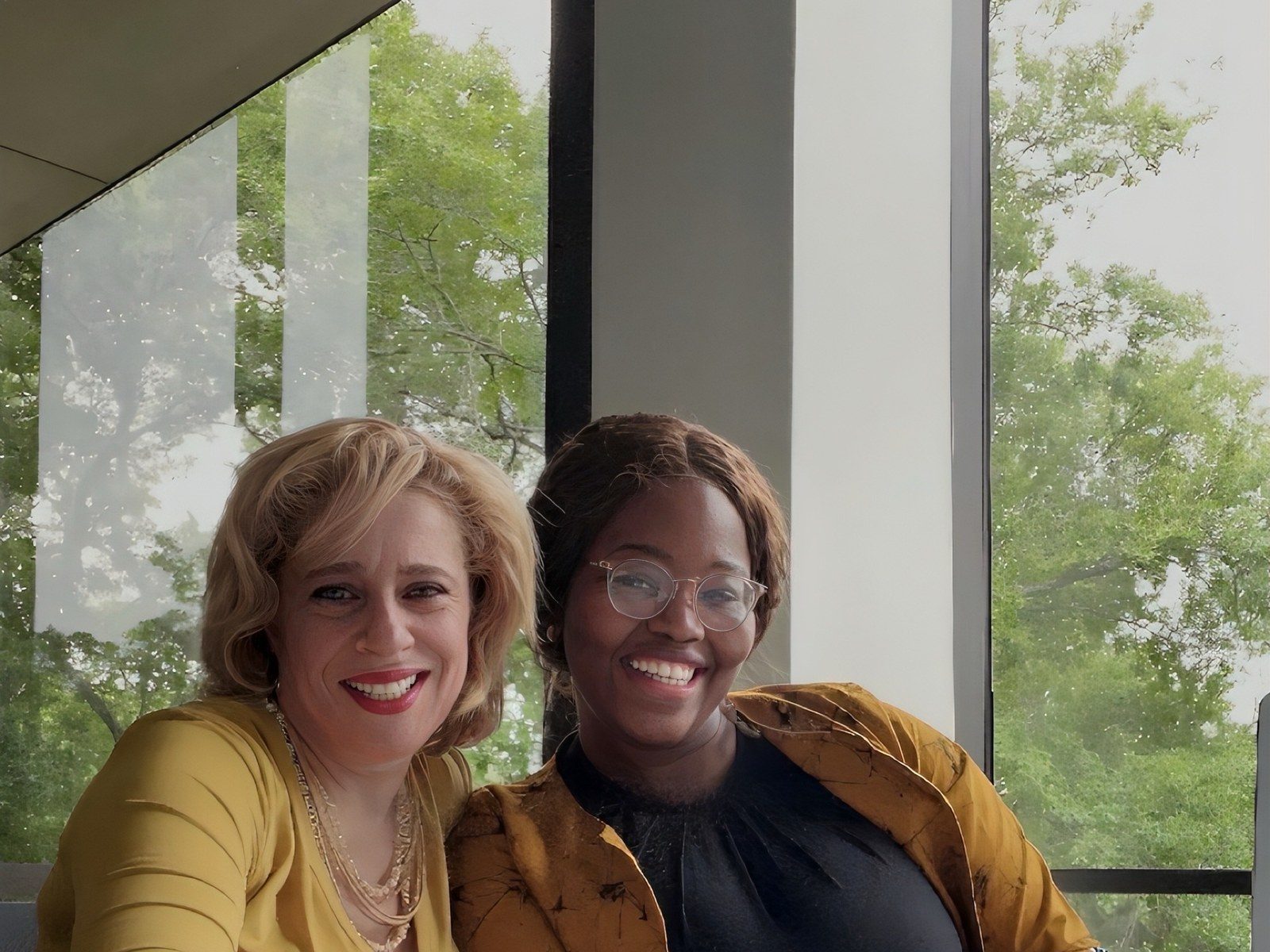
We are thrilled to celebrate a major accomplishment: Mojolaoluwa E. Bamise's publication as first author in the Journal of Applied Behavior Analysis (JABA), one of the most prestigious peer-reviewed journals in our field. Her study, "Computer-based instruction to teach professionals in Nigeria to conduct pairwise functional analyses," advances evidence-based practice in communities where access to high-quality autism services is needed.
Mojola was born and raised in Nigeria before relocating to Houston to continue her education, including earning a master's degree in Behavior Analysis at the University of Houston-Clear Lake. It is especially meaningful to see her commitment to improving autism services in her home country. Mojola is passionate about autism awareness and the destigmatisation of disability in the Global South. Her work shows commitment to empowerment through education and to expanding access to evidence-based services in Nigeria.
Mojola has many qualities that make her an exceptional behavior analyst: strong conceptual foundations, attention to detail, persistence, and a work ethic that turns ideas into published science. She led this project from conception to dissemination, presented the research at events and conferences, and contributed to a future in which Nigerian families can access high-quality autism services locally.
The need in Nigeria
Nigeria is home to approximately 230 million people, yet only a small number of individuals residing in the country hold behavior-analytic credentials. At the same time, autism prevalence estimates exceed 1.5%, revealing a huge gap between need and available services. Nigerian universities have contributed important research on autism prevalence and assessment; however, as Mojola's study indicates, there remains a need for research focused on culturally adapted interventions and funding that supports this work.
The Zeebah Foundation
This publication was made possible through collaboration with one of Nigeria's most impressive autism centers, The Zeebah Foundation, a center I have had the privilege of visiting multiple times. Located in Abuja, Nigeria, The Zeebah Foundation operates a learning center that rivals the strongest autism programs anywhere in the country. The center functions under the umbrella of a foundation born from personal experience, a common and powerful origin story among autism centers in the Global South.
The foundation's founder, Mr. Nzan Ogbe, is a successful entrepreneur with over 25 years of business experience and a parent of a child on the autism spectrum. The vision: to provide children with autism access to the tools, support, and inclusive education they deserve. The foundation's mission: "We envision an Africa where individuals with Autism and their families are educated and supported by local and global communities." A commitment enacted daily.
Behind every successful research project is someone who ensures that complex logistics become reality. For this study, that person was Ms. Marilyn Ekpe, Director of Administration at The Zeebah Foundation. Ms. Marilyn coordinated every administrative detail, managed schedules across time zones, and ensured that the six participating therapists had the resources needed to complete the training. Her graduate training in Linguistics, combined with extensive administrative experience in Nigeria's public and private sectors, positioned her uniquely to navigate both local context and the rigorous demands of ethical research. This study would not have been possible without her efforts, and we are deeply grateful to her and to the leadership of The Zeebah Foundation for their trust and collaboration.
The therapists at the heart of the study
At the heart of this study were six behavior therapists at The Zeebah Foundation who volunteered to participate. To protect their privacy, pseudonyms were used in the publication, but their contributions were extraordinary. The therapists represented diverse educational backgrounds and ethnic groups, including Yoruba, Igbo, Ijaw, and Efik. All had between three and ten years of experience working with individuals with autism and related disabilities. Three held professional certifications in applied behavior analysis (ABAT or QASP-S), and three were actively working toward credentialing. What united them was a shared dedication to learning and an unwavering commitment to the children and families they served.
The therapists completed an intensive, self-paced, computer-based training program consisting of approximately seven hours of instruction, including lectures, video models, simulated assessments, and quizzes. They completed the training independently, often using their personal smartphones and mobile data plans. Some stayed after the center closed to complete modules; others worked through the material at home during evenings and weekends.
Through this training, participants mastered complex clinical skills: conducting functional analyses, collecting and graphing data, and interpreting results to identify the function of challenging behavior. These are sophisticated assessment procedures that require precision, conceptual understanding, and sound clinical judgement. The therapists then implemented functional analyses with children at The Zeebah Foundation, achieving high levels of procedural fidelity consistent with international standards of practice.
All six children demonstrated differentiated patterns of behavior across test and control conditions, confirming that the therapists accurately identified the functions maintaining challenging behavior. These outcomes reflect both the effectiveness of the training and the skill of the participating professionals.
Why asynchronous training matters
The significance of this study is substantial. As discussed in the JABA article, asynchronous training works. Previous telehealth training models for functional analysis have relied heavily on live videoconferencing with expert trainers, an approach that presents challenges related to time zones, internet stability, and connectivity, particularly in many regions of Africa and the Global South. Even during this study, remote observation of in situ functional analyses was occasionally disrupted, requiring sessions to be recorded and shared asynchronously. A fully asynchronous training model effectively sidesteps many of these barriers.
The training incorporated Nigerian idioms, locally familiar transportation examples such as hearing an agbero shout "Lekki! Lekki!" while boarding a danfo, and culturally representative names drawn from multiple ethnic groups. These were not superficial modifications. They increased relevance, engagement, and comprehension, allowing the material to resonate with participants.
The training addressed the entire functional analysis process: conducting caregiver intake interviews, preparing the environment, implementing all four experimental conditions (attention, tangible, demand, and play), collecting and graphing data, and interpreting outcomes to determine behavioral function. The full training cost approximately fifteen US dollars per participant, primarily to cover mobile data usage. The program was built using free platforms, Curriki Studio and Google Classroom, and accessed via devices participants already owned, including Tecno Camon, Samsung, iPhone, and Redmi smartphones, as well as laptops and Chromebooks. This model is replicable without significant financial investment.
As emphasised in the publication's discussion, completion of this training does not eliminate the need for ongoing supervision by credentialed behavior analysts. Rather, it reduces the instructional burden on supervisors by establishing foundational competencies. Continued supervision remains essential to ensure ethical, safe, and effective service delivery, particularly as access to services expands.
What this means for the future
The Zeebah Foundation invests in staff development, partners with universities, welcomes program evaluation, and demonstrates what is possible when professionalism meets purpose.
Mr. Ogbe's journey, from parent to founder, illustrates how personal experience can become systemic change. His vision goes beyond a single center toward broader autism awareness and service development across Nigeria. The work of The Zeebah Foundation shows that with commitment, collaboration, and vision, centers in the Global South can meet international standards of excellence.
This JABA publication provides clear evidence that complex behavior-analytic skills can be taught effectively across continents using affordable, accessible technology. It shows that culturally responsive training can prepare professionals to implement sophisticated assessment procedures with fidelity. Future research should extend this model to additional practices, particularly function-based interventions such as functional communication training. While functional analyses identify why challenging behavior occurs, families need effective treatments. Long-term maintenance of skills should also be evaluated beyond the 4.5-week follow-up captured in this study. New approaches, including virtual reality simulations and gamified learning modules, may further improve training outcomes.
Nigerian universities continue to contribute valuable research on autism assessment and prevalence despite limited funding. Studies by Chinawa and colleagues (2016), Torty et al. (2024), and Adeola (2025) document prevalence rates ranging from 0.8% to over 2.9%, depending on region and methodology. Recent global meta-analyses (Issac et al., 2025) confirm rising autism prevalence worldwide, underscoring the urgency of this work. The Global South cannot wait for solutions to be developed elsewhere and imported. Africa needs its own research, its own evidence base, and its own trained professionals, now more than ever.
A personal note
Mojola, you have shown what is possible when passion, cultural pride, and perseverance meet rigorous science. You wore your "NAIJA MADE" stole at graduation with pride, and this JABA publication shows exactly why. You are an exceptional behavior analyst, and you are helping shape the future of autism services.
References
Adeola, D. F. (2025). Prevalence of Autism Spectrum Disorder (ASD) among Nigerian children ages 2–17. International Journal of Global Perspectives in Community Health Nursing, 2(1), 1–15.
Bamise, M. E., Lerman, D. C., & Tsami, L. (2026). Computer-based instruction to teach professionals in Nigeria to conduct pairwise functional analyses. Journal of Applied Behavior Analysis, 59, e70054. https://doi.org/10.1002/jaba.70054
Chinawa, J. M., Manyike, P. C., Aniwada, E. C., Chinawa, A. T., Obu, H. A., Odetunde, O. I., Nwokocha, A. R. C., & Ibekwe, R. R. (2016). Prevalence and socioeconomic correlates of autism among children attending primary and secondary schools in south east Nigeria. African Health Sciences, 16(4), 936–942.
Issac, A., Halemani, K., Shetty, A., Thimmappa, L., Vijay, V. R., Koni, K., Mishra, P., & Kapoor, V. (2025). The global prevalence of autism spectrum disorder in children: A systematic review and meta-analysis. Osong Public Health Research Perspectives, 16(1), 3–27.
Torty, C., Eyong, K., Asindi, A. A., & Usun, E. (2024). Autism Spectrum Disorders in Calabar, Nigeria. Iranian Journal of Child Neurology, 18(3), 75–81.