
This week Dr. Hildah Bwembya Nkonde, a dental surgeon in Ndola, sent us the first Start Here video in Bemba. She recorded it for parents raising autistic children in Zambia, in the language most parents speak at home.
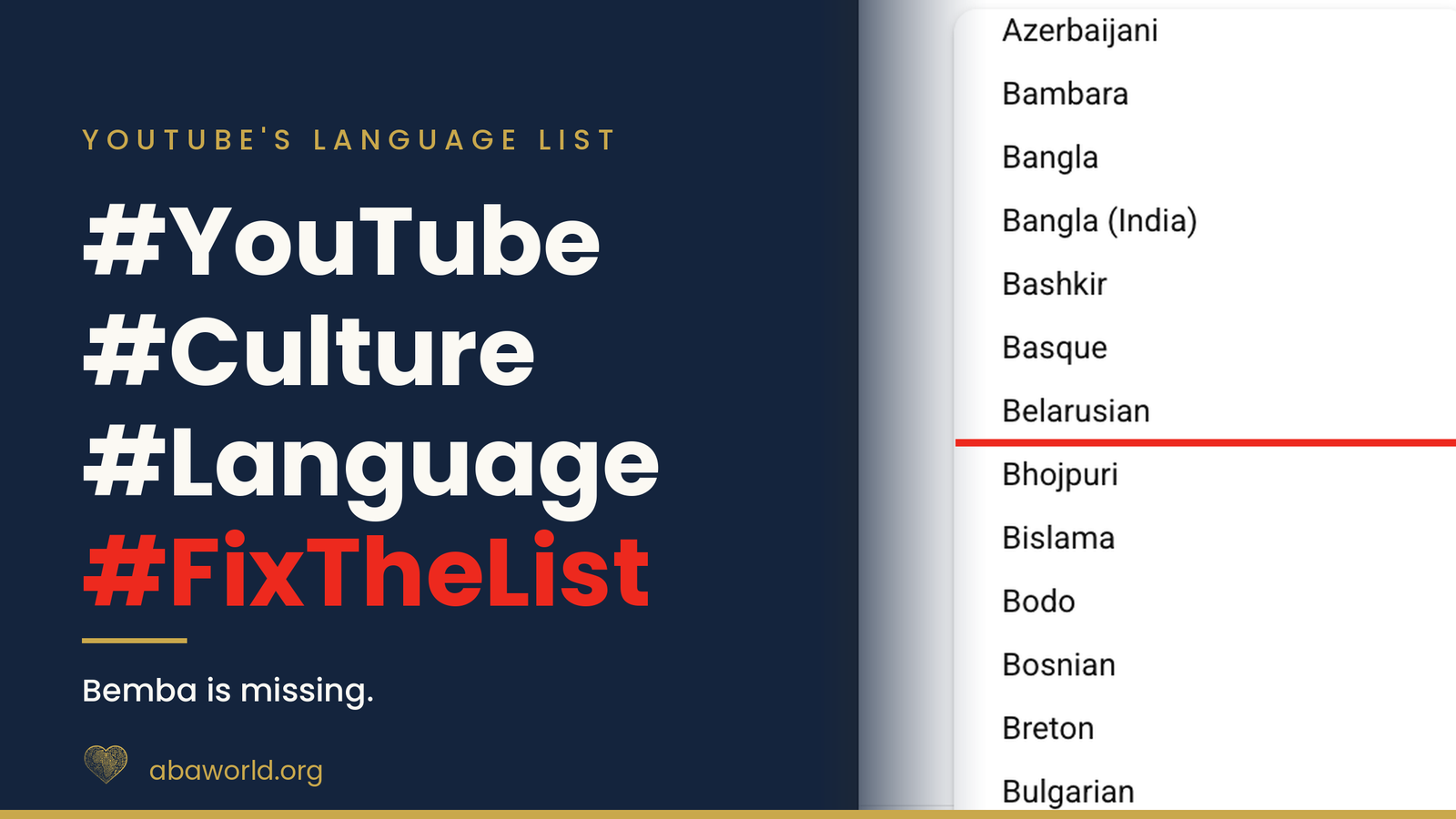
Uploading it takes a few minutes. YouTube asks you to choose the language of the video, so that a person searching in that language can find it. The list opens. Scroll to the B section. Bambara, Bangla, Bangla (India), Bashkir, Basque, Belarusian, then Bhojpuri.
Bemba is missing.
There's a search box, so try typing the word. Nothing comes back. Scroll to the end looking for a box where you write your own language, the way a form offers “other.” That box is missing too.
There are about 7,000 living languages in the world, between 1,250 and 2,100 of them in Africa, and more than 500 in Nigeria alone.1 Bemba, the most widely spoken language in Zambia, is absent from the list.
Breton is on the list. Breton is a beautiful Celtic language spoken in Brittany, in France, and UNESCO classifies it as severely endangered.3 About 107,000 people still speak it, counted in 2024.
Bemba is missing. More than four million people speak Bemba as their first language, and it is the language most Zambians use in daily life, ahead of every other language in the country.2
Last week, doing the same task, I noticed Ebira is missing as well, and Ibibio, and Bini, spoken in Edo State. Those are Nigerian languages used daily by millions of people.
Nigerian Pidgin is missing too. Counts for Pidgin run from 30 million to more than 100 million people once second-language speakers are included.4 Sino records our Pidgin videos for those families. The list has no place to say so.
According to the register kept by SIL International, these languages already carry an international identifier, assigned years ago by the body that catalogs the languages of the world.5 Bemba is bem. Nigerian Pidgin is pcm. Ibibio is ibb. Bini is bin. The languages are listed into the record of humanity. The YouTube dropdown menu listed only some chosen ones.
Between November 1884 and February 1885, fourteen states met in Berlin and drew borders across an entire continent.6 Twelve of them sat in Europe. The people who lived on the land were absent from the room, and the one African head of state who asked to send a representative, the Sultan of Zanzibar, was refused.
A century of school, court, government, and paperwork conducted in the language of whoever had arrived. The children are taught that their mother's language belonged at home and the other language belonged in the world. A hundred and forty years later, we allow companies like YouTube to choose languages of higher significance?
On September 4, 2026, the United Nations voted 164 to 1, with six abstentions, to adopt the Equal Earth projection.7 Togo led the effort for the African Union. The old Mercator map made Greenland appear roughly the size of Africa, when Africa is about fourteen times larger.
Generations of children grew up with a picture of the world that quietly shrank their own continent. Correcting it took one vote and a great deal of patience.
Things change when people demand change.
Hildah's video with guidance for a mother of an autistic child in Bemba exists. However, the platform holding that video has filed it under a language it declines to name.
Google arrived a century after Berlin, a hundred and forty years apart.
The existing language list may be a standard one, trimmed to the markets where the product sells advertising, shipped, and left alone. Most people in that room could find their own language, so the gap doesn't matter. The omission seems to be not important.
Does this pattern consistently come from somewhere? Choosing languages at random out of seven thousand would be unlikely to produce a list that holds a severely endangered language of 107,000 speakers while skipping one used by most of Zambia. Is something systematic being shaped? What is the rule? By what measure does Breton qualify and Bemba fall short? Speaker numbers point the other way by a factor of forty. Does official status point the other way?

To YouTube and the other platforms. Add the languages that already carry an international code. The codes are public and the list is finished, so the work is small. Then add an empty box, so a person can type the language you left out. Those two changes cost you little and give a continent its name back.
To the African Union and to governments. The map took a resolution and a vote. Language belongs on the same agenda, with the same patience.
To organizations making content. Record in the languages families actually speak, and say so publicly when the tools decline to carry them. Our silence reads as agreement.
To parents, and to anyone reading this. Speak your language to your children, and name it out loud wherever a form asks. Pride in your language, your food, your clothes, and your traditions costs very little and holds a culture together.
Doing nothing is being complicit
Accepting the way things are supports whoever built them. In 1953, Albert Einstein wrote a short note about Pablo Casals, published two years later, and the line has stayed with me:8
The world is in greater peril from those who tolerate or encourage evil than from those who actually commit it.
Those of us with a computer and five spare minutes can be the voice. Silence from people who could speak is read, fairly, as consent.
Loukia Tsami, MA, BCBA, LBA
Founder, ABA World
References
1. Language counts for the world, for Africa and for Nigeria: Ethnologue, Languages of the World, SIL International. ethnologue.com
2. Bemba first-language speakers, 4.1 million, from census figures reported by Ethnologue. Bemba is the language of daily communication for 31 percent of the population, the largest share of any language in the country, in the 2010 Census of Population and Housing, Zambia Central Statistical Office.
3. Breton: about 107,000 speakers in a 2024 survey, and severely endangered in the UNESCO Atlas of the World's Languages in Danger. UNESCO World Atlas of Languages
4. Nigerian Pidgin: 30 million speakers in Ethnologue's estimate, and about 120 million including second-language speakers in figures reported for 2020.
5. ISO 639-3 codes are maintained by SIL International as the registration authority for the standard. iso639-3.sil.org
6. Berlin Conference, 15 November 1884 to 26 February 1885, ending in the General Act of 26 February 1885. Fourteen states attended, twelve of them European, along with the United States and the Ottoman Empire. No African state was represented.
7. United Nations General Assembly, resolution on correcting the map, adopted 4 September 2026 by 164 votes to 1. Introduced by Togo on behalf of the African Group. UN Meetings Coverage GA/12779 and UN News
8. Albert Einstein, note on Pablo Casals written in 1953, published in J. Ma. Corredor, Conversations with Casals, 1955.