
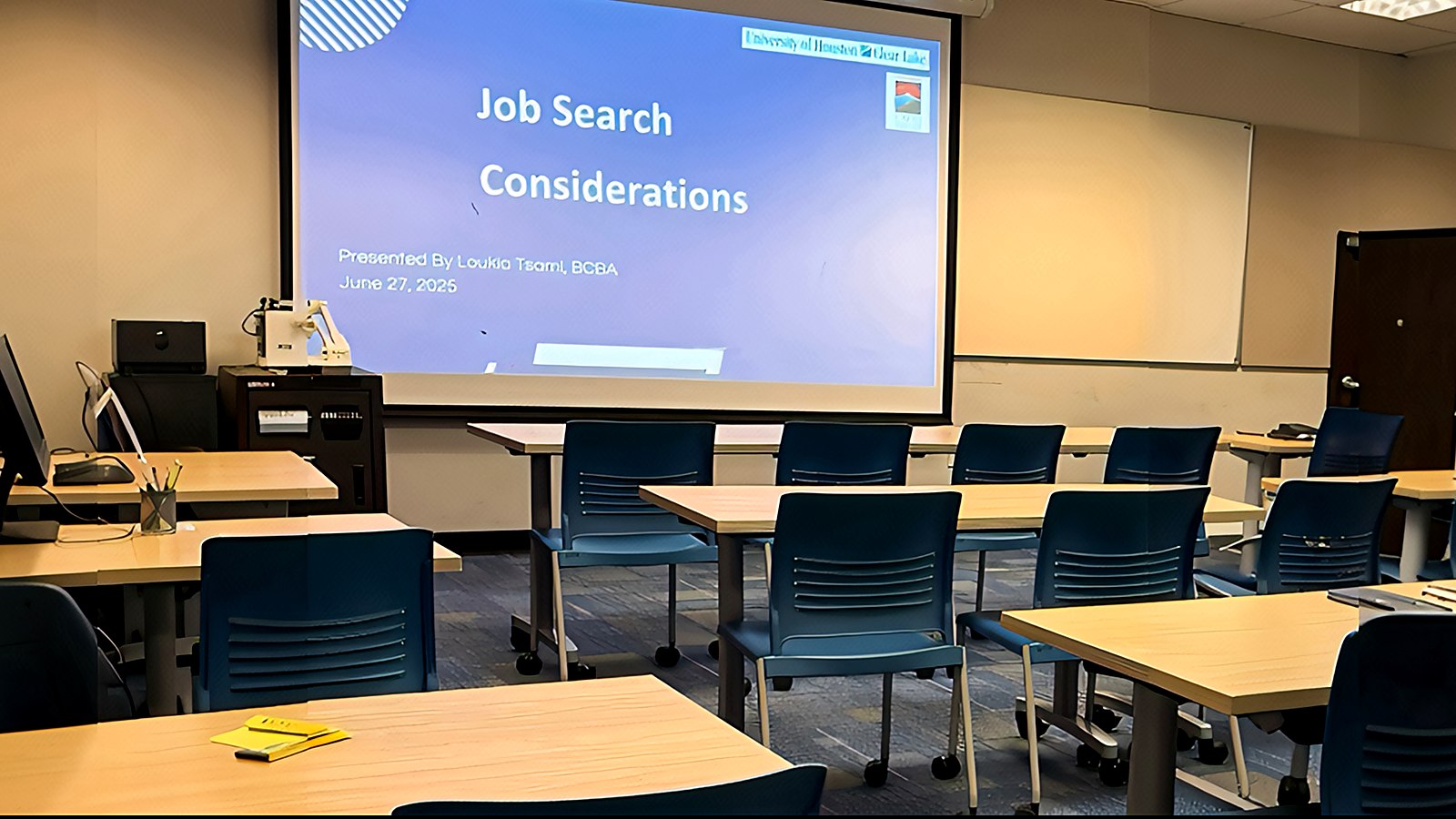
This semester, Wednesday mornings are busy. We get ready for our weekly two-hour Helping Hands session that starts at 10 a.m. and brings together consumers from the community, students from four high schools, and participants from the vocational clinic on campus.
We prepare the large CEP room, every week a little differently, as the tasks change while we count down the weeks to the garage sale. Set up the computer system, PPT, and projector; print the materials, handouts, agenda, and datasheets for the volunteers. Bring the parking passes and laptops from ABASkIP for the marketing team. Get the cashier and money for the financial team to role-play, the scripts for the customer service guys, the inventory items, and snacks from the coordinator’s room. Anita likes to put on some soft, welcoming music and a cute cartoon on the large screen to set the right vibe. We know that preparing well makes the process easier.
While I was printing the sign-in sheets in my office yesterday, I saw an email arrive from Dorothea with, “I believe this may be of interest.” She was right. A pause, a few lines read, and then rushed back to the room. But it was in my head all day until there was finally time to sit with it properly.
The Texas Workforce Commission (TWC), together with the Governor’s Committee on People with Disabilities, has opened the 11th annual Texas HireAbility campaign.1 Governor Greg Abbott announced October 2026 Disability Employment Awareness Month in Texas. Good news!
Throughout October, TWC and its partners will hold job fairs and disability-awareness events across the state. On October 21, the Texas HireAbility Employer Forum will take place at the Collin College McKinney Campus Conference Center, where the Lex Frieden Employment Awards will also be presented.2 Eleven years of a state campaign encouraging employers to include Texans with disabilities. A low-cost way to inform people and reduce stigma.
Nearly two million Texans with disabilities are currently in the workforce, according to the Governor’s statement, and TWC reports that more than 700,000 Texans with disabilities hold a bachelor’s degree or higher. That’s a lot of people!
TWC also operates the We Hire Ability employer recognition program. A Texas business qualifies when at least 10% of its workforce consists of employees with disabilities, and receives a decal to display at the business and online. The October forum will have organizations already engaged in this work, including Cleanlogic, Gaylord Texan Resort & Convention Center, the City of Fort Worth, and CVS. We plan to attend, another blog is coming.
And then there is Lex Frieden. For us in Houston, his name has great significance. He served as Executive Director of the National Council on Disability when the Council produced the first draft of what became the Americans with Disabilities Act, and he did that work while living here.7 The history of the ADA includes many people, advocates, policymakers, attorneys, people with disabilities, and organizations, and Houston was part of that. So there is a lot to celebrate.
But, what comes after awareness?
At the end of the announcement, TWC reports that its Vocational Rehabilitation program served more than 71,000 participants last year and helped more than 10,000 Texans with disabilities achieve their employment goal.1 Numbers are beautiful, but definitions are important here. Those two numbers measure different things. People may receive Vocational Rehabilitation services over an extended period, so it would not be appropriate simply to divide 10,000 by 71,000 and call the result a success rate.
We have to consider, of the cases that closed, how many people got competitive integrated employment? What were their wages and weekly hours? How many were still employed six months later, and twelve? How many advanced in their jobs?
Answers to these questions would tell us what worked, and these data would be relatively easy to publish. The data could be presented in a table, once a year, and could be released during the awareness month. Employment at closure, median wage, weekly hours, retention at six and twelve months. Texas already collects this information. Publishing it would allow an annual analysis every October.
Texas already has wonderful Vocational Rehabilitation services and resources for employers and for Texans with disabilities. The services already exist, making them easier to navigate (especially for the consumers) is a good next step, and it could begin with a two-page simple process.
One page for the employer, answering the first questions. I want to hire a person with a disability. How do I start? Where do I find qualified candidates? Who helps with reasonable accommodations, and who pays for them? If support is needed after someone is hired, who do I contact?
One page for the Texan consumer with a disability, answering the same question from the other side. I want to work. How do I start? How do I apply for Vocational Rehabilitation services, and what happens after I apply? What help is available with job preparation, interviews, transportation, workplace accommodations, job coaching, assistive technology, and keeping a job once I have one? Clear steps, in a way that will be easy to follow.
There may also be opportunities to expand incentives for employers. Federal and state funding already supports Vocational Rehabilitation services, and Texas already pays wages directly for paid work experience. Under TWC’s requirements for local workforce boards, the board pays the participant’s wages, currently at a set rate of $19.96 an hour, and TWC reimburses the board for the hours worked.3 Other programs have used incentives such as temporary wage support, assistance with training, accommodations, or other employment costs.
European countries have used employer incentives for decades, including wage subsidies and reductions in employer social-security contributions. The European Commission’s 2025 review of programs across the 27 EU Member States found a wide range of approaches and mixed results, which matters.5 Incentives by themselves settle little, and how they are designed is what decides whether they work.
During the 1990s, our work included HELIOS II, the European Community’s action program for disabled people, which ran from 1993 to 1996, with visits to services in Scotland, the Netherlands, Sweden and Greece.6 Vocational training, employment, and independent living were the themes then as well.
Could some of these ideas be expanded or modified in Texas to help employers make the transition from a temporary work experience to permanent employment? The goal would not be to subsidize a job indefinitely, but to give the employer and employee an opportunity to work together, with support, and then measure whether the employment continues after that support fades out.
Another variable is transportation. For many people with disabilities, getting a job is only one difficult task. Getting to the job may be a factor determining whether employment is possible at all. A plan that includes transportation is of great value.
Vocational Rehabilitation is a federal-state partnership under the Rehabilitation Act. Federal regulations establish a federal share of 78.7%, with states responsible for the remaining share.4 That tells us how the broader VR program is financed, but not much about how much funding is allocated specifically to Texas HireAbility, or how much support is available for individual employment barriers.
How much funding supports the campaign? What resources are available for transportation, job coaching, assistive technology, workplace accommodations, and other barriers that determine if employment is possible? Texas already collects that information, publishing it costs little, and many questions become easier to answer.
If only one of these happens, let it be the table.
Real inclusion must include people with severe autism, and others who need significant and ongoing support to work. Employment will look different for them, but it is still employment. A system built mainly for people who reach independence quickly leaves everyone else outside it.
Awareness matters, hiring matters, retention and growth matter too. Next Wednesday morning, we will again set up the room, get the scripts, the laptops and practice being the cashier or the customer service person. Texas HireAbility gives our work visibility.
Congratulations to everyone at the Texas Workforce Commission and the Governor’s Committee on People with Disabilities on the 11th year of Texas HireAbility.
The views expressed here are my own and do not represent those of my employer or of any organization with which I am affiliated.
By Loukia Tsami, MA, BCBA, LBA
Behavior analyst and researcher, Houston
Thank you to the advocates at the Texas chapter of the National Council on Severe Autism for a conversation that shaped part of this.
References
1. Texas Workforce Commission. (2026, October 1). TWC announces 11th annual Texas HireAbility campaign [Press release]. twc.texas.gov
2. Texas Workforce Commission. Texas HireAbility Campaign. twc.texas.gov/texashireability
3. Texas Workforce Commission. Board VR Requirements, Chapter 2: Wage Services for VR Participants in Paid Work. twc.texas.gov
4. U.S. Department of Education. 34 CFR § 361.60, Matching requirements.
5. European Commission, Directorate-General for Employment, Social Affairs and Inclusion. (2025). Incentivising employment of persons with disabilities in the open labour market: Mapping of national policies, strategies and measures.
6. European Commission. Third Community Action Programme for Disabled People (HELIOS II), 1993 to 1996. cordis.europa.eu
7. National Council on Disability. Equality of Opportunity: The Making of the Americans with Disabilities Act.